
1. Supply Chain Volatility: Breaking Silos in High-Concurrency Global Networks
Global omni-channel retail and supply chain networks represent some of the most complex organizational systems, characterized by high-volume transactions and multi-layered logistics. Processing hundreds of thousands of daily e-commerce checkouts requires frontend storefronts, order management systems (OMS), international customs brokers, and WMS platforms to sync seamlessly in real-time. Without a structured Enterprise Architecture (EA), supply chain conglomerates suffer from significant revenue leakage and shipping delays.
Supply chain bottlenecks are concentrated across three core blind spots:
- Cascading Failures from Rigid System Connections: Storefront systems and customs clearing brokers are often connected via point-to-point, hardcoded API scripts. This setup is highly fragile: a single change in a partner's data model triggers a domino-like crash across warehousing networks, stalling container shipments at ports.
- Runaway TCO from Redundant "Zombie" IT Assets: Because regional branches purchase systems independently, conglomerates run dozens of mismatched ERP and WMS platforms. Paying licensing and support fees for duplicate software layers creates a massive IT cash drain.
- Cross-Departmental Friction and Data Inconsistencies: Logistics, procurement, and sales divisions frequently use mismatched definitions for core master data (e.g., SKU dimensions, item profiles). Transferring assets across department lines triggers manual reconciliation over email, causing severe shipping lead-time delays.
To streamline global logistics pipelines, supply chain leaders must commit to architectural modernization. We offer our bespoke Global Retail & Agile Supply Chain Solution, binding software assets to three-level capability maps for smooth operations.
2. Core Supply Chain Modernization Modules
We optimize supply chains across three distinct pillars: Dependency Decoupling, Software Rationalization, and Conversational AI:
1. System Dependency Audits & API Decoupling
Leveraging our non-intrusive topology scanners, we trace all active API streams between procurement, billing, and warehouse systems. We automatically flag undocumented "shadow interfaces" and protocol mismatches, replacing rigid point-to-point connections with clean API contracts to eliminate single points of failure (SPOF) and boost failover capacities.
2. Application Rationalization via the TIME Framework
We run a comprehensive cataloging of all WMS, CRM, and ERP assets in use across regional branches. Applying the TIME model, we eliminate duplicate or obsolete platforms, migrate standard operational modules into core platforms, and significantly lower global IT TCO.
3. ALEX for Calls: Autonomous Fleet & Supplier Coordination
To streamline container loading, dispatch timelines, and raw supplier compliance checks, we deploy ALEX for Calls. The voice agent contacts hundreds of third-party logistics firms in hours, validating delivery slots and generating structured reports to end labor-intensive manual dialing.
💡 Case Study: Saving $2M Annually for a Top 100 FMCG Distributor
For a leading Australian FMCG and cold-chain distributor managing 8 central distribution centers and 3,000+ retail storefronts, decentralized IT selection created severe API conflicts, inventory leaks, and billing overlaps. We aligned their logistics value streams with standard business capability maps. Applying the TIME matrix, we decommissioned or consolidated 28 redundant software layers and shadow IT assets. This slashed annual software licensing and maintenance overhead by $2.1 million in year one, reduced order drops to zero, and optimized cold-chain dispatch latency.
3. Specialized Retail & Supply Chain Control Modules
Our retail and supply chain solution covers high-value operating scenarios including:
| Scenario | Embedded AI Control Points & Automation | Mitigated Risks & Vulnerabilities |
|---|---|---|
| Global Omni-Channel Customs Integration | Introduce microservices and standard API contracts, configuring automatic alerts and smart fallbacks for offline partner systems. | Prevents extensive port cargo lockups and heavy contract penalties caused by customs integration drops. |
| Logistics Fleet Automatic Dispatch | Embeds AI operational controls at dispatch planning nodes; ALEX for Calls automatically dials freight drivers to verify shipments and dispatch routes. | Prevents idle runs, delayed dispatches, and hours of manual coordination calls. |
| Multi-ERP Data Lineage Realignment | Construct standard enterprise SKU data glossaries, automatically mapping processing lineage across sales and ledger systems. | Eliminates stock discrepancies and inventory over-allocations from mismatched SKU formats. |
| HNW Bulk Purchase Lead Capture | Deploy ALEX for Websites on bulk ordering pages, engaging corporate leads with compliant bulk trading schedules. | Bypasses cold-lead dropout rates caused by long, tedious commercial inquiry forms. |
4. Logistics Efficiency & Operational Reductions
Dismantling data and pipeline barriers triggers significant competitive advantages for retail brands:
- 40% Reduction in Supply Chain Lead Times: Automated order routings and voice dispatches remove cross-departmental bottlenecks to accelerate shipping.
- 30%+ Slashing of Software OPEX: TIME-based rationalization removes redundant code assets, replacing spaghetti integrations with secure, decoupled APIs.
- Zero Order Drops and Near-100% System Uptime: Robust API gateways protect active inventories under peak holiday shopping surges, keeping databases aligned.
Lightweight operations, globally connected. Built upon deep enterprise architecture and local regulatory expertise in Australia, we decouple complex interfaces to transition your supply chain into a highly agile logistics powerhouse.
5. Global SKU Synchronization & WMS Event-Driven Architectures
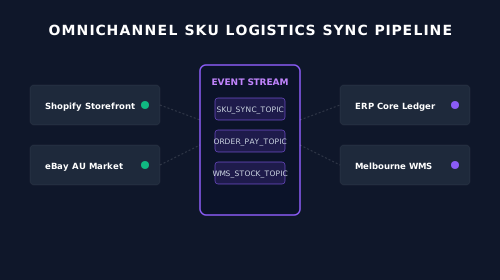
Multinational retail brands suffer from severe checkout leaks and stock oversells due to real-time inventory updates lagging behind across storefronts, platforms, and third-party logistics. We assist clients in designing resilient Event-Driven Architectures (EDA). Utilizing secure API gateways or event buses (such as Kafka), we build lightning-fast channels between storefronts, WMS, and ERP platforms.
The millisecond an online checkout occurs, the architecture broadcasts physical inventory adjustments globally. Our automated diagnostic trackers monitor order states to instantly flag anomalies from data loss or API latency, reducing shipping lead times. By eliminating redundant manual audits and consolidating returns management, we slash material and operational waste to ensure your supply chain captures premium margins.
6. Business & Technology Evolution Assurance
In complex group governance and omnichannel digital programmes, ensuring a smooth transition of architecture assets and operating workflows is central to our delivery. BUSINESS ARCHITECT GURU PTY LTD applies an Iterative Decoupling Blueprint so large organisations can reorganise capabilities or replace legacy ERP finance cores while keeping critical hubs fully available (zero-downtime operational continuity).
Our specialists guide business and technology leaders through phased validation: first, isolated sandbox simulation of business rules to surface boundary and cascade risks; second, MECE-based modular rollout with lightweight webhook handshake tests; third, ALEX agent health checks embedded in core interfaces for continuous operational monitoring.
Through changing market conditions, Business Architect Guru remains your strategic technology partner. Under strict NDAs, sensitive topology and API catalogues from audits and simulations run only on hardened, locally isolated infrastructure—with disciplined delivery that clears overlap and de-risks your digital transformation.
7. Melbourne Localised Delivery & Governance
Headquartered in Broadmeadows, Melbourne, Victoria (VIC 3047), BUSINESS ARCHITECT GURU PTY LTD operates a Localized Delivery Matrix for mid-market and multinational clients. Blueprints must reflect local market and regulatory realities—our senior consultants work on-site at your Melbourne operations hub for full-lifecycle process audits.
Implementation follows MECE: capability and role mapping to quantify overlap waste; local sandbox data models aligned to ASIC, APRA, and AML/CTF; then loosely coupled integration via API webhooks to Jira, ServiceNow, SAP, and Salesforce—strengthening your core hub and enabling agile AI operations.