1. The Silent Outage: Tight Couplings & Integration Gaps
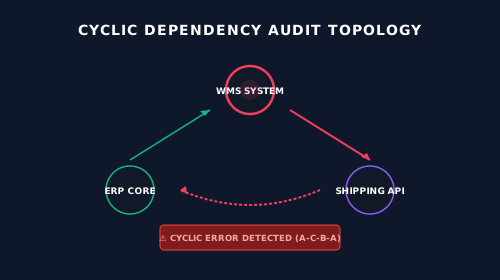
As enterprises introduce new digital databases, data sharing and API calls expand exponentially. To meet near-term strategic goals, engineering teams frequently write point-to-point hardcoded API couplings. While this quick-fix "glue integration" resolves immediate needs, it binds the organization in a silent technical tangle.
Uncontrolled legacy system dependencies pose severe risks to mid-to-large corporate operations:
- Integration Gaps (Broken Chains):Many critical APIs lack proper contract definitions. When front-line systems change database attributes or backend databases update schemas without sync, data pipes snap unexpectedly, resulting in transaction failures or billing discrepancies.
- Single Point of Failure (SPOF):Vast application stacks often rest on a single, legacy API or a custom macro built by a departed employee. When this unmonitored node hangs or suffers query latency, it triggers a multi-system cascade outage, freezing the entire value stream.
- Systemic Upgrade Paralysis:When planning core ERP or billing migrations, complex integration webs freeze development. Teams cannot map the cascade effects of replacing System A, paralyzing the enterprise in a state where change is too risky to initiate.
To secure operations, leaders must institute formal Integration & Dependency Audits. Precise mapping of data flows and rationalized APIs decouple fragile dependencies to build resilient enterprise systems.
2. Data Lineage & Integration Contract Diagnostics
Our dependency audit methodologies evaluate software assets across three core architectural layers:
1. Non-Invasive API Dependency Mapping
Our engine ingests API specs and Swagger documentations, mapping global endpoints without code modifications. It highlights unofficial database queries and unused, legacy APIs to guide portfolio cleanups.
2. Data Lineage Tracking & Consistency Verification
We track critical business properties (Order ID, Tenancy Status, Asset Valuation) across databases. It pinpoints discrepancies caused by sync lags, securing data integrity between front-office and back-office pipelines.
3. Cascade Impact Analysis & Sandbox Emulation
By linking interface models with value streams, the simulator forecasts the outcome of decommissioning System A. It flags downstream bottlenecks and capability drops to ensure zero-risk ERP and CRM migrations.
💡 Real-World Success: Preventing a Supply Chain Freeze Caused by a Case-Mismatch
While advising a global manufacturer, a billing update altered an API return key from "Delivery_Status" to lowercase "delivery_status". Because downstream shipping and customs databases relied on a hardcoded link, this case mismatch broke all shipping syncs. Over 300 high-value cargo containers stalled at customs. Our architects deployed the scanner, isolated the letter-case error in 30 minutes across millions of lines of active code, and patched the pipeline, averting massive contract penalties.
3. Four Core Diagnostic Modules in Integration Audits
Our dependency diagnostic framework ensures system availability through targeted audit categories:
| Module | How it works | Risk removed |
|---|---|---|
| Single Point of Failure (SPOF) | Detecting high-volume hub nodes in IT networks that lack active replicas or failover options. | Eliminating risks of single application crashes freezing entire cross-functional systems. |
| API Contract Auditing | Testing query schemas, timeouts, and exception handling logic to grade endpoint health. | Preventing silent data drops or workflow halts triggered by unscheduled API updates. |
| Data Lineage Auditing | Measuring sync latency and transaction attributes across database pools. | Avoiding double-billing or dashboard error risks caused by stale warehouse data. |
| Shadow IT & Legacy Cleanup | Locating unauthorized department scripts and tracking zero-activity API subscriptions. | Pruning licensing opex and closing unmonitored backdoors to secure customer files. |
4. Organisational Benefits
Dissolving complex legacy integrations and adopting event-driven interfaces yields immense strategic benefits:
- Near-100% continuity: API gateways and circuit breakers replace fragile point-to-point hard coding for resilient operations.
- High-Velocity Strategic Upgrades: Clear lineages allow teams to plan ERP, CRM, or data warehouse cloud migrations with 80% shorter discovery cycles.
- Massive Maintenance Savings: Decommissioning zombie APIs and shadow IT frees developers from debugging cycles, saving over 20% in system integration costs.
5. BUSINESS ARCHITECT GURU Operational & Technological Resilience Mechanism
In complex group governance and omnichannel digital programmes, ensuring a smooth transition of architecture assets and operating workflows is central to our delivery. BUSINESS ARCHITECT GURU PTY LTD applies an Iterative Decoupling Blueprint so large organisations can reorganise capabilities or replace legacy ERP finance cores while keeping critical hubs fully available (zero-downtime operational continuity).
Our specialists guide business and technology leaders through phased validation: first, isolated sandbox simulation of business rules to surface boundary and cascade risks; second, MECE-based modular rollout with lightweight webhook handshake tests; third, ALEX agent health checks embedded in core interfaces for continuous operational monitoring.
Through changing market conditions, Business Architect Guru remains your strategic technology partner. Under strict NDAs, sensitive topology and API catalogues from audits and simulations run only on hardened, locally isolated infrastructure—with disciplined delivery that clears overlap and de-risks your digital transformation.
6. Melbourne Localised Delivery & Governance
Headquartered in Broadmeadows, Melbourne, Victoria (VIC 3047), BUSINESS ARCHITECT GURU PTY LTD operates a Localized Delivery Matrix for mid-market and multinational clients. Blueprints must reflect local market and regulatory realities—our senior consultants work on-site at your Melbourne operations hub for full-lifecycle process audits.
Implementation follows MECE: capability and role mapping to quantify overlap waste; local sandbox data models aligned to ASIC, APRA, and AML/CTF; then loosely coupled integration via API webhooks to Jira, ServiceNow, SAP, and Salesforce—strengthening your core hub and enabling agile AI operations.