
1. The Silo Trap: Departmental Barriers & Functional Mismatch
As an organization scales, it almost inevitably falls into the trap of siloed management. Administrative departments build heavy operational walls as they optimize for local KPIs. To address immediate demands, individual business units purchase overlapping software applications and construct redundant workflows, leading to fragmented processes and duplicated administrative efforts.
The consequences of functional mismatch are severe. At the operational level, cross-departmental tasks stall, causing massive bottlenecks, long approval delays, and high drop-off rates. Structurally, C-level executives lose a clear view of strategic assets. Leaders see climbing headcounts and IT budgets, yet cannot define which capabilities drive competitive advantage or measure the financial waste of fragmented workflows.
To cure these systemic issues, brute-force layoffs or restructuring fail, often triggering operational friction. The only viable remedy is introducing a standardized, objective architecture language. This is "Business Capability Modeling" under the BIZBOK framework. By separating what the enterprise does from who performs the work, leaders can systematically align capability maps with organizational structures.
2. The Paradigm Shift: Business Capabilities vs. Administrative Functions
Before starting alignment, we must clear the common misconception of treating capability and administrative department as synonyms:
| Dimension | Business Capability | Function/Org |
|---|---|---|
| Core Definition | What an enterprise does to deliver business value. | The administrative unit or person performing the physical work. |
| Stability Profile | Extremely high. Core capabilities remain stable even during reorganizations or workflow transformations. | Relatively low. Subject to frequent restructuring, shifts in leadership, or geographic expansion. |
| Scope of Impact | Cross-functional and cross-system. E.g., Lead Management spans marketing, sales, and support. | Siloed. Each administrative department focuses only on its vertical fragment of the workflow. |
| Resource Mapping | Bridges people, processes, data, and applications into an integrated block to deliver value. | Often acts merely as a siloed container for headcount (FTEs) and system budgets. |
If an enterprise deploys IT infrastructure based solely on administrative departments, it guarantees fragmented applications. Decoupling business capabilities from organational departments provides reusable building blocks that secure strategic agility.
3. AI-Driven Capability & Function Alignment Solutions
As a pioneer in enterprise architecture and workflow governance, our capability alignment methodology integrates an advanced AI semantic audit engine. Using non-invasive scans, we map functional boundaries, detect overlap, and streamline cross-functional synergies.
1. Multi-Tier Business Capability Mapping (LCM)
We guide enterprises to strip away complex org trees and define standard three-tier business capability maps. Each capability block outlines clear inputs, outputs, data assets, and governance rules, establishing a single source of truth.
2. Administrative RACI Heatmapping
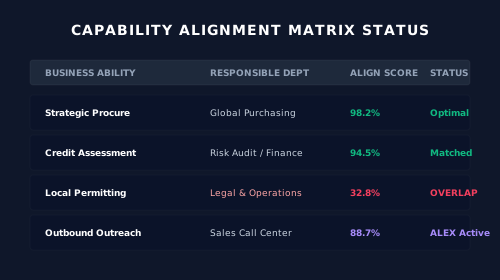
By mapping abstract capability nodes against administrative business units (RACI matrix), the platform measures operational ownership and opex ratios. The AI engine highlights hidden capability overlaps (such as parallel procurement or duplicate contract validations), generating intuitive resource waste heatmaps.
3. Value Stream Alignment & Process Diagnostic (BPM)
While capabilities define assets, value streams dictate flow. We map physical departmental steps to end-to-end value streams, calculating delay friction, manual intervention ratios, and process gaps to provide re-engineering recommendations.
4. Strategic Alignment & Closed-Loop Cascading
We decompose high-level corporate strategies (e.g., expanding cross-border services or lowering logistics waste) and link them to capability nodes. By establishing health metrics, leaders can monitor actual performance, securing high-fidelity cascading when strategic goals evolve.
💡 AI Semantic Auditing: Exposing "Shadow IT" & Unofficial Functions
In large enterprises, individual business units often build shadow IT databases or macro spreadsheets to avoid complex IT procurement cycles. Our AI auditing engine analyzes natural-language workflow logs and spec descriptions, identifying duplicate shadow capabilities with 95% accuracy to support architectural cleanups.
4. Tangible Value: What Alignment Delivers
Aligning capabilities with organization units unlocks massive operational dividends:
- Eliminate Administrative Overlap & Redundant Opex:Identify and merge overlapping organizational units and licensing assets. SSC consolidation cuts overall administrative friction and opex by 15% - 25% on average.
- Accelerate Workflows & Minimize Customer Churn:Compress handoff times between corporate silos by over 65%. Smoother value streams minimize operational leakage and secure customer retention.
- Targeted IT Capital Allocation:Eliminate separate localized systems. Centralize funding toward robust service interfaces aligned to unified corporate capabilities, maximizing digital ROI.
- Modular Mergers & Acquisitions:When managing corporate transitions, M&As, or agility adjustments, simply plug and play modular capability building blocks, cutting transition times by over 70%.
Aligning capabilities with functional units is more than a technical exercise; it is a scientific compass for organizational change. Levering our extensive local advisory expertise, we partner with your team to organize corporate operations and build resilient architectures.
5. Technical Detail: Semantic Matching Algorithms
To deliver high-precision alignment, our AI engine leverages state-of-the-art NLP models. First, it ingests unstructured documentation, job profiles, and Jira logs, transforming them into multi-dimensional vectors based on pre-trained industry dictionaries.
Second, it runs cosine similarity calculations against reference BIZBOK and TOGAF trees. If an administrative unit's tasks map to multiple unrelated nodes, it flags "functional mismatch" in red. This mathematical precision speeds up discovery, helping architects build optimized RACI ownership matrices.
6. Business & Technology Evolution Assurance
In complex group governance and omnichannel digital programmes, ensuring a smooth transition of architecture assets and operating workflows is central to our delivery. BUSINESS ARCHITECT GURU PTY LTD applies an Iterative Decoupling Blueprint so large organisations can reorganise capabilities or replace legacy ERP finance cores while keeping critical hubs fully available (zero-downtime operational continuity).
Our specialists guide business and technology leaders through phased validation: first, isolated sandbox simulation of business rules to surface boundary and cascade risks; second, MECE-based modular rollout with lightweight webhook handshake tests; third, ALEX agent health checks embedded in core interfaces for continuous operational monitoring.
Through changing market conditions, Business Architect Guru remains your strategic technology partner. Under strict NDAs, sensitive topology and API catalogues from audits and simulations run only on hardened, locally isolated infrastructure—with disciplined delivery that clears overlap and de-risks your digital transformation.
7. Melbourne Localised Delivery & Governance
Headquartered in Broadmeadows, Melbourne, Victoria (VIC 3047), BUSINESS ARCHITECT GURU PTY LTD operates a Localized Delivery Matrix for mid-market and multinational clients. Blueprints must reflect local market and regulatory realities—our senior consultants work on-site at your Melbourne operations hub for full-lifecycle process audits.
Implementation follows MECE: capability and role mapping to quantify overlap waste; local sandbox data models aligned to ASIC, APRA, and AML/CTF; then loosely coupled integration via API webhooks to Jira, ServiceNow, SAP, and Salesforce—strengthening your core hub and enabling agile AI operations.