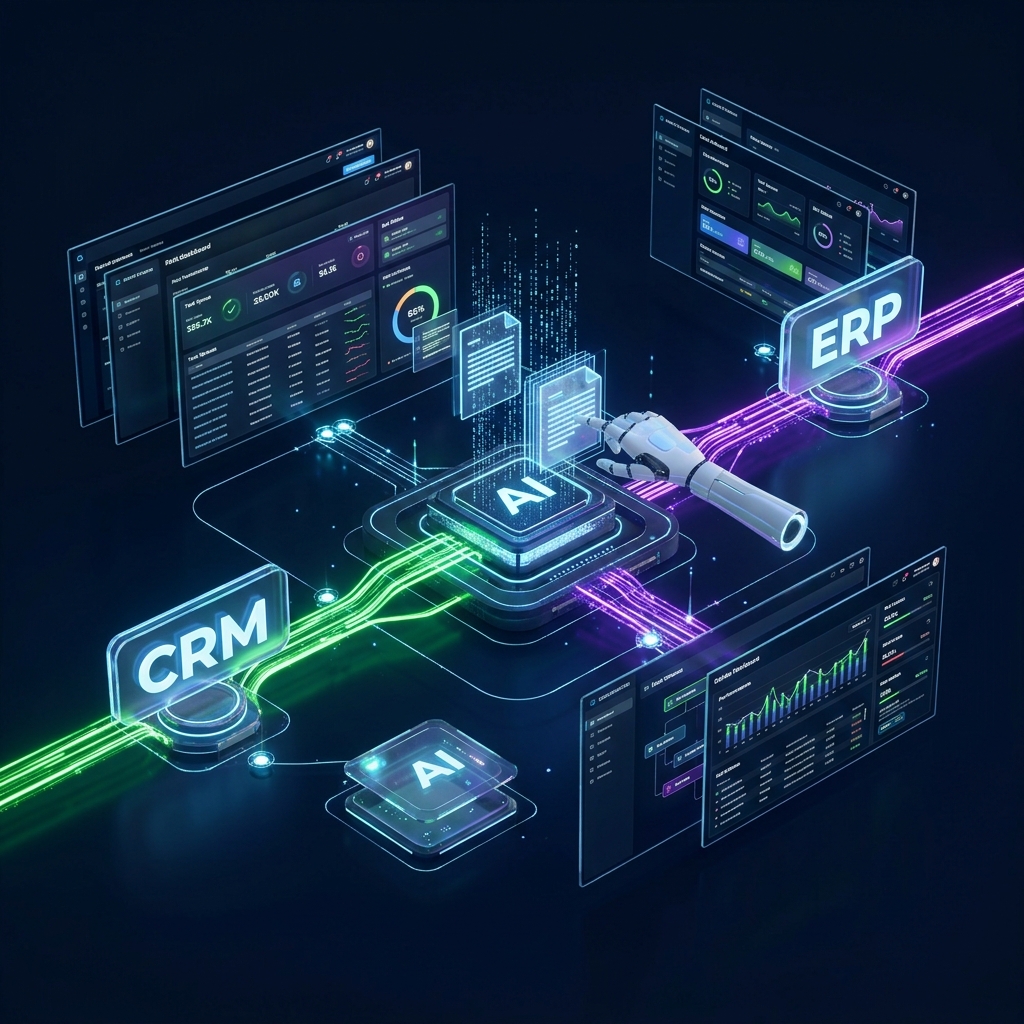
Discover how we bridge critical applications, establish robust master data taxonomies, deploy loosely coupled ERP/CRM integrations, and launch end-to-end automated workflows.
Across long digital journeys, businesses frequently mistake "buying premium software" for "digital transformation success." This bias costs firms dearly. Throughout our implementation governance practice, BUSINESS ARCHITECT GURU PTY LTD has advocated that "business architecture defines IT systems, and IT systems serve operational flows." A premium digital ecosystem must not only optimize active workflows but also enforce rigid data-governance standards and microservices decoupling to prevent siloed system architectures.
The following two case studies capture our hands-on system modernizations for a precision factory and a global retail supply chain. We guided our clients through secure system migrations that preserved custom workflows and dismantled data silos.
This mid-sized precision factory manufactures custom components for automotive and instrumentation brands. As transaction volumes expanded, structural flaws in their IT setup became severe: frontline sales units operated a CRM platform that was completely disconnected from the WMS and ERP systems used by production and inventory managers.
We identified several critical bottlenecks: First, frontline sales reps could not check real-time factory floor inventory or staff schedules before closing deals. Lead times promised to customers were guessed manually, resulting in frequent delivery delays. Second, sales leads and invoice routings relied on manual data entry across systems. This manual copying had an 8.5% error rate and caused substantial information lags. Third, early contractors had hardcoded database integrations between the CRM and ERP to cut corners. Consequently, updating a customer profile in the CRM triggered database-level crashes in back-office ERP ledgers, paralyzing upgrades and freezing operations.
Business Architect Guru's technical team designed a custom "Capability-Driven IT Realignment Project":
First, we mapped and separated the boundaries for "Order Fulfillment" and "Material Planning." Using an Enterprise Service Bus (ESB) layer, we established clean API contracts that decoupled CRM and ERP databases in code.
Second, we created automated Inventory-to-Capability rules. Live raw material volumes and line schedules from the ERP were wrapped as standardized services. When a salesperson enters an order in the CRM, the system queries WMS logs in 3 seconds, computes exact delivery dates via automated business rules, and locks down raw inventory, replacing spreadsheet handoffs and errors. We also deployed a data reconciliation loop to guarantee cross-system master data consistency.
Decoupling and modernizing their application core resolved their operational friction, yielding excellent outcomes:
The client is a global retail supply chain group running nearly 100 outlets and major online distribution hubs. With soaring logistical complexity, they coordinate daily inventories, invoices, and returns with thousands of external suppliers.
Our audit revealed several key bottlenecks: First, supplier platforms were completely heterogeneous and disconnected. A back-office team of 20 spent hours manually logging into dozens of supplier portals to download invoices, copy receipts, and reconcile accounts, creating huge labor costs and errors. Second, the group lacked standardized SKU taxonomies. Identical products had different names and units across retail stores, warehouse locations, and finance ledgers, making physical inventory reconciliation take 7 days and causing a 2.4% order drop rate. Third, interface management was chaotic. Lacking a unified middleware layer, IT engineers wrote custom adapters for every new partner, incurring massive maintenance costs and killing supply chain flexibility.
To break through these bottlenecks, Business Architect Guru consultants implemented a comprehensive "Data Governance & RPA Automation Project":
First, we established global SKU master data specifications, formatting tens of thousands of items into a clean dictionary. By implementing an Enterprise Service Bus (ESB), we deployed a unified Adaptor Gateway that standardized external supplier data formats, making new integrations completely plug-and-play without custom coding.
Second, for legacy partner systems lacking API pathways, we configured intelligent Robotic Process Automation (RPA). We built ALEX automation agents to simulate user log-ins at night across supplier portals. The agents download inventory registries and receipts, validate formats against the master data dictionary, and sync records into WMS and ERP databases automatically, securing zero-touch accounting.
The deployment of our platform successfully modernized the client's logistical core:
Reviewing these two comprehensive transformations, BUSINESS ARCHITECT GURU PTY LTD formulated our proprietary Decoupled Organizational Alignment & IT Integration Model. We are convinced that successful business transformation is never about purchasing expensive software or raw head-count cuts. It requires establishing a 100% clear, unambiguous mapping across four layers: Strategy, Business Capability, Value Stream, and IT Interfaces.
In our practice, we emphasize two core principles: First, business capabilities must serve as the primary, stable building blocks, decoupled from volatile administrative structures and underlying software code. Second, point-to-point hardcoded database couplings must be upgraded into loose connections via API Gateways, Enterprise Service Buses (ESB), or Webhooks. Only then can enterprises swap out systems like Lego blocks to adapt to rapid market changes or cloud migrations, avoiding wasted IT investments.
As a professional consulting hub rooted in Broadmeadows, Melbourne (VIC 3047), we maintain a completely independent and objective stance. Following rigorous MECE principles and delivering academic-level quality, we protect and enhance your digital blueprints. By integrating ALEX automation agents into existing application dependencies, we guide organizations into a transparent, agile, high-performance operational era.
For multinational firms expanding in Australia and Oceania, we emphasize custom localized value streams and regulatory safeguards. In our case studies, our consultants tailored workflows around Victorian bylaws and Council rules to help clients resolve capacity overlaps and legacy technical debt. We deployed robust RACI matrices and Master Data Management (MDM) schemas to break through corporate silos.
By integrating ALEX intelligent agents without disrupting legacy systems, we enabled clients to respond to inquiries in 2-4 hours, reducing operational costs by 20% to 35% and easily passing strict corporate audits. With superior professional standards and local delivery, we guarantee your digital transition runs on a fully compliant path, securing long-term capital relationships and smooth market entry.