
1. Application Sprawl: A Common Enterprise Challenge
Years of decentralised purchasing and projects have left many organisations with overlapping applications and weak enterprise architecture governance—creating an expensive, fragile IT landscape.
Mid-to-large entities often run dozens of similar systems for finance, HR, CRM, ERP, and data platforms. The cost shows up as:
- Budget drain: Duplicate SaaS licences, hosting, and vendor support—including zombie apps few people use.
- Data silos: Inconsistent fields and spaghetti integrations built with glue code and manual workarounds.
- Cascade failures: Undocumented dependencies mean small API changes can trigger widespread outages.
Architects need capability-led application rationalisation—not one-off fixes—to break the technical debt cycle.
2. Capability-Led IT Inventory & Dependency View
Business Architect Guru maps every application to level-three business capabilities—not isolated technical parameters:
1. Functional duplication
When more than two apps serve the same capability (e.g. multiple CRMs for lead follow-up), the platform flags overlap with evidence for consolidation.
2. Dependency mapping & impact simulation
AI topology scanning reveals data, API, and database links—highlighting tight coupling and running what-if impact when systems change or retire.
3. TCO & technical debt rating
Apps are scored on business fit, technical fit, and total cost of ownership to surface high-maintenance, low-value candidates.
Case study: 40% application reduction for a logistics group
TIME-based rationalisation helped a national logistics client retire redundant platforms and reclaim licence spend within the first programme year.
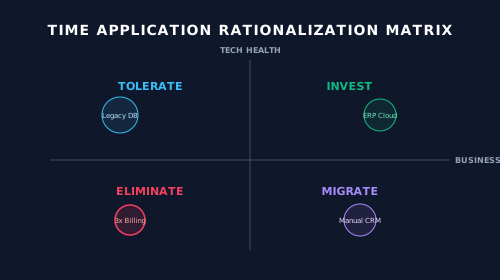
3. TIME Rationalisation Model
We apply the TIME matrix to classify each application:
1. Tolerate
Strong fit and technology—retain in the standard portfolio.
2. Eliminate
Low value, obsolete technology—plan decommissioning.
3. Invest
High business value, dated platform—fund modernisation.
4. Migrate
Overlap with a stronger host—consolidate data and retire duplicates.
4. Benefits of Dependency Governance
A rationalised portfolio delivers:
- 25–40% OPEX reduction in year one through licence and hosting consolidation.
- Higher availability via API gateways and circuit breakers instead of hardcoded links.
- Faster change through reusable services and configurable workflows.
- Cleaner cloud migration—only valuable apps move to the cloud.
Technology should accelerate business outcomes. BUSINESS ARCHITECT GURU PTY LTD combines local delivery experience with AI topology discovery to remove waste and de-risk transformation.
5. Graph-Based Dependency Analysis
Applications become graph nodes; APIs, queues, and database links become directed edges. AI calculates centrality and cycle risk to find merge candidates and redundant subscriptions.
6. Business & Technology Evolution Assurance
In complex group governance and omnichannel digital programmes, ensuring a smooth transition of architecture assets and operating workflows is central to our delivery. BUSINESS ARCHITECT GURU PTY LTD applies an Iterative Decoupling Blueprint so large organisations can reorganise capabilities or replace legacy ERP finance cores while keeping critical hubs fully available (zero-downtime operational continuity).
Our specialists guide business and technology leaders through phased validation: first, isolated sandbox simulation of business rules to surface boundary and cascade risks; second, MECE-based modular rollout with lightweight webhook handshake tests; third, ALEX agent health checks embedded in core interfaces for continuous operational monitoring.
Through changing market conditions, Business Architect Guru remains your strategic technology partner. Under strict NDAs, sensitive topology and API catalogues from audits and simulations run only on hardened, locally isolated infrastructure—with disciplined delivery that clears overlap and de-risks your digital transformation.
7. Melbourne Localised Delivery & Governance
Headquartered in Broadmeadows, Melbourne, Victoria (VIC 3047), BUSINESS ARCHITECT GURU PTY LTD operates a Localized Delivery Matrix for mid-market and multinational clients. Blueprints must reflect local market and regulatory realities—our senior consultants work on-site at your Melbourne operations hub for full-lifecycle process audits.
Implementation follows MECE: capability and role mapping to quantify overlap waste; local sandbox data models aligned to ASIC, APRA, and AML/CTF; then loosely coupled integration via API webhooks to Jira, ServiceNow, SAP, and Salesforce—strengthening your core hub and enabling agile AI operations.