
1. Architectural Misalignment & Process Challenges in Modern Enterprise
In today's rapidly shifting global market, business success no longer depends solely on isolated product innovation or short-term marketing. Instead, it relies on the operational elasticity of the entire organization and the health of the underlying business architecture. However, after initial rapid expansion, mergers, or cross-regional growth, most enterprises fall into a state of structural misalignment. Typical symptoms include: severe overlap in responsibilities across departments, fragmented information transmission chains, a disconnect between underlying IT systems and business workflows, a massive buildup of hardcoded application dependencies, and a lack of real-time visibility for executives into actual business capability distribution, leading to low ROI and failed strategic initiatives.
Misalignment often stems from the lack of a shared business blueprint language. Lines of business and IT struggle to trace process changes to application impacts; duplicate apps create spaghetti architectures that slow transformation.
2. BIZBOK & TOGAF Integrated Architecture Governance Framework
As specialists in business architecture modeling and optimization, we (BUSINESS ARCHITECT GURU PTY LTD) believe that effective governance must be business-strategy-driven, and IT systems must closely align with core business capabilities. Our proprietary framework seamlessly integrates the BIZBOK (Business Architecture Body of Knowledge) framework with the TOGAF (The Open Group Architecture Framework) enterprise standard.
Through our governance practices, we reconstruct your enterprise foundation across these core pillars:
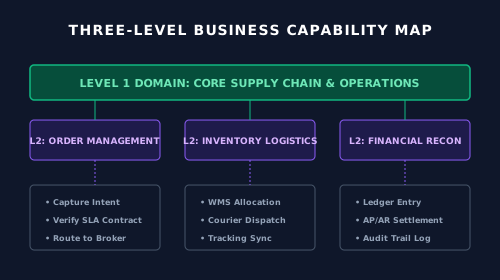
- Business Capability Mapping: Capabilities are the foundational building blocks of enterprise architecture. We peel back complex organizational structures to identify and model your core business capabilities, building a 1:1 three-level capability map. This pinpoints redundant capability investments, ensuring clear ownership and optimal resource allocation.
- Value Stream Mapping: While capabilities describe what a business "can do," value streams represent "how value is delivered to customers." We systematically map end-to-end value streams across departments, identifying bottlenecks, information lag, and non-value-adding waste to achieve peak operational stream efficiency.
- Organizational Realignment & Resource Optimization: Operationalizing abstract capability maps and value streams into daily routines. Through precision organization mapping, we eliminate administrative redundancies, streamline cross-functional collaboration, and design strategy-aligned KPI and RACI matrices to maximize human capital efficiency.
- Information & Data Mapping: Clarifying the conceptual entities and data flows circulating within core business processes. We eliminate data silos caused by inconsistent terminology, establishing a unified enterprise glossary and core data asset blueprint to provide standardized inputs for underlying application integration and data warehouse development.
💡 Deep Architecture Philosophy: Decoupling Organization & Systems Using Capability-Centric Design
Traditional systems are often tightly bound to specific administrative departments or temporary projects. Consequently, any changes to departmental structures or software applications halt the entire workflow. We advocate for a capability-centric architecture that decouples business capabilities from specific organizational structures and underlying software code. This loose coupling ensures that when organizational restructuring or IT modernization occurs, systems can be easily swapped like building blocks, maximizing business resiliency.
3. Our Core Services
1. Business Capability Modeling & Organizational Design
Using advanced capability-modeling techniques, we analyze strategic objectives to build a comprehensive capability spectrum spanning strategic, tactical, and supporting levels. We eliminate redundancies caused by person-centric roles, and design flat, value-delivery-centric matrix organizations to support highly efficient business flows.
2. Business Process Audits, Optimization & Re-engineering (BPR)
Leveraging quantitative Business Process Management (BPM) and process-mining technologies, we run a systematic diagnosis on end-to-end workflows. We pinpoint high-friction, repetitive, or lagging nodes to execute deep business process re-engineering (BPR), significantly shortening cycle lead times and improving operational smoothness.
3. Cross-Departmental Collaboration & Cost Reduction Schemes
Addressing "organizational silos" and collaborative gaps common in multi-business lines, we design standardized cross-departmental collaboration rules and integration flow logics. By streamlining redundant roles and consolidating overlapping operational backbones, we formulate targeted cost-reduction strategies to cut administrative overhead.
4. Strategic Execution & KPI Metrics Cascade Design
We translate high-level strategic visions into measurable, executable architectural objectives. Utilizing Balanced Scorecards (BSC) and business architecture KPI alignment, we cascade corporate goals into specific capability enhancements and process improvements, ensuring strategy is backed by data and continuous calibration.
4. Anticipated Outcomes
Through deep architecture partnership, your organisation gains durable competitive advantage:
Outstanding Organizational Agility
Decoupled capability maps reduce pre-research time by over 60% when responding to new business requirements, enabling rapid workflow reconfiguration to seize fleeting market opportunities.
Sustainable Cost Reduction
By eliminating overlaps in administrative work and redundant IT structures, average operational overhead across standard workflow nodes is slashed by 20% to 35%, dismantling departmental silos.
High-Fidelity Strategic Execution
Strategic decisions and resource allocations from executive leadership are cascaded 100% down to actual operational nodes, significantly boosting final transformation success rates.
Seamless IT Modernization Foundation
A clear and stable business blueprint provides a robust specification baseline for system selections, ERP/CRM implementations, and cloud migrations, preventing wasted IT investments.
Enterprise architecture governance is a comprehensive strategic evolution. Rather than merely handing over an aesthetic report, we actively coach your management team through standardized, measurable steps, deeply embedding this blueprint into daily operations to build a highly resilient organization.
5. Business Capability Modeling (BCM) & Process Diagnosis Details
To deliver pixel-perfect blueprints to medium-to-large enterprises, our consulting team implements a highly systematic three-level Business Capability Tree (BCM) construction process during on-site audits. Level 1 focuses on Strategic Positioning & Core Functions (e.g., high-level supply chain resource pooling and international regulatory compliance risk control). Level 2 aligns with Measurable Standard Operating Domains (e.g., multi-warehouse inventory master data synchronization and Fair Work labor standard validation). Level 3 links directly to Underlying Technical Interfaces & Execution Tickets (e.g., specific API webhooks handshake states and CRM sales lead flows).
During the Business Process Re-engineering (BPR) stage, we systematically introduce process-mining technologies and quantitative efficiency models. By capturing real-time timestamps of transaction documents in databases, we map out high-fidelity physical value streams. This model pinpoints idle wait times, manual reconciliations, and hardcoded API failures with split-second precision. Applying the MECE principle, we streamline redundant roles, consolidate duplicate operations hubs, and build a sturdy foundation for sustainable, long-term cost reduction.
6. Business Architect Guru Continuity & Evolutionary Safeguards
In complex corporate governance and omni-channel digital transformation projects, guaranteeing a smooth transition of architectural assets and operational workflows is our core mandate. We (BUSINESS ARCHITECT GURU PTY LTD) have designed a proprietary "Iterative Decoupling Blueprint". This evolutionary framework mitigates system-wide disruptions during modernizations, ensuring that while business capabilities are restructured or legacy ERP financials are replaced, core business operations achieve 100% continuous uptime (Zero Downtime Operational Continuity).
Our specialists guide business and technology leaders through phased validation: first, isolated sandbox simulation of business rules to surface boundary and cascade risks; second, MECE-based modular rollout with lightweight webhook handshake tests; third, ALEX agent health checks embedded in core interfaces for continuous operational monitoring.
Regardless of how volatile the macroeconomic environment becomes, Business Architect Guru remains your reliable strategic and technological foundation. We strictly adhere to our Non-Disclosure Agreements (NDA). All sensitive topologies and API schemas analyzed during auditing and sandbox simulations are run on highly secure, isolated local servers. With unmatched professional integrity and academic-level delivery standards, we clear away organizational barriers and pave a path for your digital journey.
7. Melbourne Consulting Hub Localized Enterprise Delivery Matrix
As a professional consulting hub rooted in Broadmeadows, Melbourne, Victoria (VIC 3047), BUSINESS ARCHITECT GURU PTY LTD has constructed a high-fidelity "Localized Delivery Matrix" tailored for local large enterprises and multinational subsidiaries. We recognize that even the most academically sophisticated architectural blueprints are meaningless if disconnected from local market dynamics and regulatory landscapes. Our senior consultants embed directly into your Melbourne operations hub to execute comprehensive, end-to-end process audits.
During implementation, we follow a rigorous MECE methodology to assist your business in a smooth transition. First, we perform an enterprise-wide capability and functional mapping audit to precisely quantify efficiency loss from duplicate divisions or tightly coupled software. Second, we configure data-auditing pipelines within localized, high-security sandboxes to ensure 100% compliance with ASIC, APRA, and AUSTRAC (AML/CTF) regulations. Third, we execute a loose-coupling ESB re-engineering, establishing one-click API Webhook pathways to bridge systems like Jira, ServiceNow, SAP, and Salesforce. This guarantees your information backbone remains rock-solid, eliminates redundant software silos, and secures a painless launch into a lean, AI-powered operations era.